I Tried Everything They Recommended. Then I Found Out Why None of It Could Work.

The 3AM wake-up is a GABA problem. Melatonin is a timing hormone. These are different systems. I had already found Magnesium Glycinate. I just had the wrong dose and the wrong mechanism. It took three nights to confirm what nobody had explained in over a year.
Sarah Kellerman
Sarah Kellerman, Women's Wellness Educator & Sleep Researcher
14 Years in Practice 10 min read

After experiencing the 3AM waking pattern personally for over a year, Sarah now works specifically with women navigating hormonal sleep disruption in midlife.

— This Article Is For You If —
  • You fall asleep without much trouble — but wake up between 2AM and 4AM and cannot get back
  • You have tried melatonin at multiple doses and it did not fix the wake-up problem
  • Your brain switches on fully at 3AM and you lie there for an hour or more while your body is exhausted
  • You have been told by a doctor that your labs are normal and it is probably just stress
  • You have tried three or more sleep supplements and none of them touched the specific problem
  • You have stopped expecting this to be fixable — but you are still reading
If any of this describes the last several months of your life, this is the article I wish someone had handed me fourteen months earlier.
I Tried Everything They Recommended. Then I Found Out Why None of It Could Work.

I ran that math every morning for fourteen months.

How many hours did I get. What does that number mean for today. What did I lose.

This pattern shows up in two different ways, and both of them fail for the same reason.

For some women it is what I had: waking at 3AM fully alert, brain completely on, lying still for an hour or more while the house is dark and silent. For others it is the opposite end: lying awake until midnight or later, body completely depleted, mind that will not stop processing. Both feel different from the outside. Both come from the same underlying system. And both have been failed by the same category of solutions for the same reason — a reason I am going to explain in this article.

I had the 3AM version. But if you have either version, keep reading. The explanation is the same.

What I eventually found out is something I had never seen in any article, any product description, or any doctor's office across fourteen months of searching. When I found it, every single product I had tried — the melatonin, the magnesium, the well-known three-ingredient sleep protocol, the CBD — made complete sense as a failure. Not because they were wrong products. Because they were all solving the same wrong problem.

I need to show you what that looked like before I tell you what the actual problem was, because the reason they all failed the same way is the reason what I eventually found worked.

There is no dramatic way to describe what fourteen months of broken sleep costs because the cost does not look dramatic from the outside.

I still showed up. I still performed. I held everything together in the ways that count as counted.

The people around me saw functional. They saw present. They did not see the rest of it.

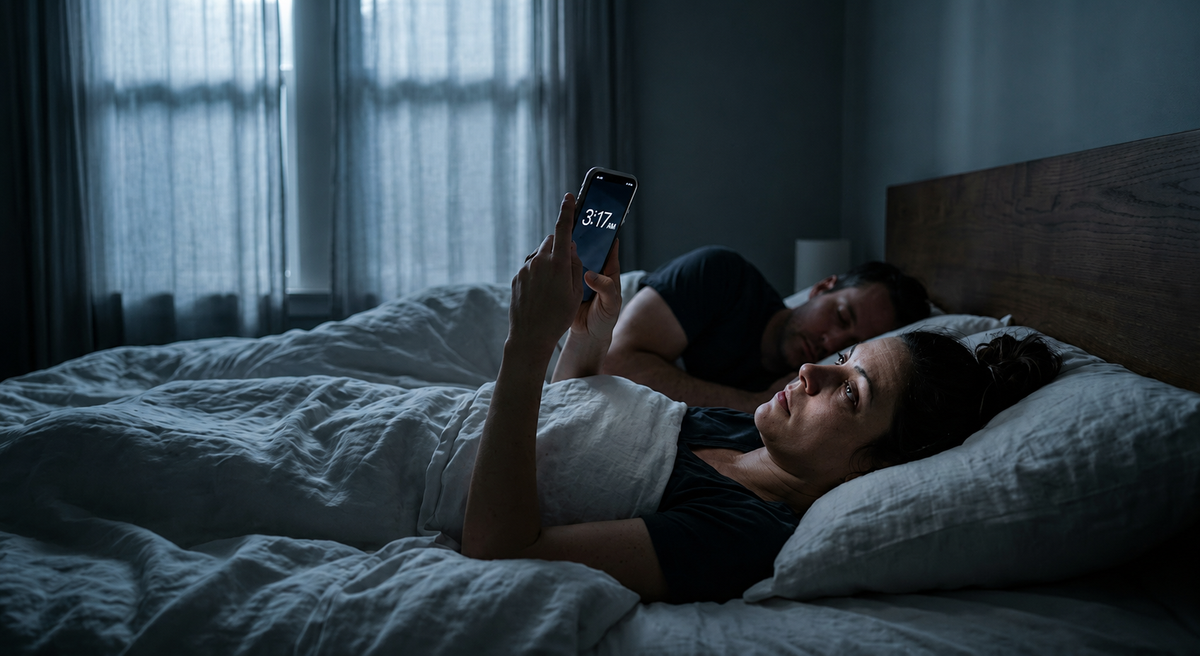
Awake at 3AM

My daughter started waiting until after school to tell me things.

I heard her say it to her friend through the kitchen wall while I was standing on the other side making coffee. She said wait until after lunch, mom's tired in the morning.

She is ten. She did not decide this consciously. She learned it the way children learn things, from the evidence of living with a person long enough.

My youngest told his friend's parent that I am always tired. With the casual accuracy children use for things they have not yet learned to soften.

I snapped at my daughter over a backpack on the stairs.

The look on her face before she picked it up and walked away without saying anything. I thought about that specific look at 3AM for the next four nights.

None of this is what waking up at 3AM looks like from a distance.

From a distance it looks like being a little tired.

From the inside it looks like the slowly accumulating cost of a deficit nobody can see, distributed across every part of your life in amounts just small enough that nobody names any single one as a crisis.

I stopped describing my nights to my husband. Not because things got better. Because I had used up the words.

So I say fine when he asks how I slept, and I mean functional, and I move on.

He lies asleep beside me in four minutes. He lives in a body that simply sleeps.

I lie next to him and feel a specific loneliness I have no name for — not estrangement, but a distance created by the fact that there is no bridge between those two experiences.

Bedtime used to be the best part of the day. Now it is the part I delay.

Because I know what I am probably walking into.

The ritual that used to be restoring has become something I brace for — lying down and immediately calculating how much sleep I will get if I fall asleep in the next twenty minutes, knowing what it means if I do not.

Month Ten: The Decision I Am Not Proud Of

I tried to fix it for fourteen months.

I want to be precise about what I tried because I am exhausted by the implication that people with broken sleep have not tried hard enough or given things adequate time. Every single thing I tried was aimed at the same system. I did not know that yet. I found out later why that mattered — and why it explains every failure on this list, in order.

Eight Products. One Wrong Assumption. The Same Result Every Time.

Melatonin first, because melatonin is always first. Three milligrams, then five, then ten.

Supplement bottles shelf

Four months of escalation that produced exactly one result: morning grogginess without the sleep it was supposed to be buying.

I would wake at 3AM with my brain completely switched on and then drag through until noon with the residue of a hormone that had timed itself for my morning rather than my night.

The dose escalation was me trying harder at the wrong thing.

Magnesium Glycinate next. Not magnesium — Magnesium Glycinate specifically.

I had read enough to know the difference. The oxide from the pharmacy had poor bioavailability and I was not going to waste another month on the wrong form. I found the Glycinate myself, through my own research.

Two nights in the first week I slept through and I held this as cautious progress, the kind you hold at arm's length because you know what hope costs when it does not resolve.

By week three the improvement was inconsistent. By week six I was back to baseline.

Another almost-empty bottle on the shelf. The ingredient was right. Something else was off. I did not know yet what that was.

Then the well-known three-ingredient sleep protocol, assembled from separate purchases because I was going to do it the way the research actually described.

Magnesium L-Threonate, L-Theanine at two hundred milligrams, apigenin. Six weeks. No deviations.

The L-Theanine did something real: the transition into sleep became calmer and faster. I held this as progress. Falling asleep had never been my problem.

The 3AM wake-up was unchanged throughout all six weeks.

The protocol addressed my non-problem beautifully. The actual problem it never touched.

Researching on phone at night

I did not know yet that there was a name for what I had been doing for over a year. I was not trying the wrong products. I was trying the right category of products for the wrong mechanism. Every single one of them — the melatonin, the magnesium, the stack, the CBD — was built for Phase 1. My problem was Phase 2. Nobody had explained to me that those were different things. I found that out at month thirteen, in a forum, from a woman who had no reason to be selling me anything.

CBD for two months at fifty-five dollars a month because it was a different mechanism and I needed a different mechanism. Results I could not confirm were real. When I stopped and the baseline was identical, that told me what I needed to know.

Sleep hygiene the entire time. Blackout curtains. Sixty-seven degrees. No screens after nine-thirty. Blue light glasses after seven. No caffeine after noon. Five-minute body scan every night.

I was doing everything. Not most things. Everything.

The sleep hygiene content online is written for people who are doing things wrong. I was not doing anything wrong.

I was lying in a sixty-seven degree room having done a body scan, awake, running the list.

Around month ten I stopped expecting to fix it. Not dramatically. Quietly.

I arrived at a conclusion I did not say out loud: this category does not work for me. I was going to live with it. I structured things around it. I stopped making plans that required being alert in the mornings. I told myself this was coping, which is the word you use for surviving something you have stopped expecting to fix.

I held that conclusion for three months. Then I found out why everything had failed — and it was not what I expected. It was not that I was the exception the solutions did not cover. It was that I had been handed the wrong solution for a correctly identified problem. The problem was real. The treatment had been aimed at something adjacent to it.

Here is what I eventually found out.

What Changed Things Was Not Another Product

What changed things was not another product. It was an explanation I had never been given.

I came across it in a forum, from a woman who had no reason to be selling me anything.

Moment of recognition while reading

She described the 3AM wake-up in a way that was accurate to my own experience down to details I had never seen written. And then she described something I had not read in any of the year and a half of searching I had done.

She wrote that the sleep onset mechanism and the sleep maintenance mechanism are separate biological systems governed by separate chemistry.

Falling asleep is primarily a circadian and adenosine event: melatonin signals that nighttime has arrived, sleep pressure has built, the brain prepares to transition.

This is the system melatonin addresses. It manages timing. It manages the beginning of sleep.

Staying asleep once you are there is something else entirely.

The GABAergic pathway is the brain's primary inhibitory system. GABA is the signal that says the threat is not real, the day has ended, the nervous system can stand down. When this system is functioning well, the brain cycles through sleep stages without surfacing into wakefulness. When it is insufficient, the brain crosses back into consciousness at the lightest point in the sleep cycle, around 3AM, and it does not go back under.

Melatonin has nothing to do with this. It cannot tell a brain that has woken at 3AM that it is safe to go back to sleep. That is a completely different biological pathway and melatonin is not part of it.

I read this three times.

Then I thought about the four months of melatonin escalation. The ten milligrams. The morning grogginess I had been carrying as the only result.

I had been taking a timing hormone for a GABA problem.

I could have taken melatonin for four more years and the 3AM wake-up would have continued because I was never addressing the mechanism that was causing it.

I was not the exception the solutions did not cover. I had been given the wrong solution for a correctly identified problem. The problem was real. The treatment was aimed at something adjacent to it for fourteen months.

The Reason Nothing You Tried Could Fix the 3AM Problem

What Was Actually Happening
Two Systems. Two Problems. One Had Been Ignored.
What Melatonin Addresses
Sleep Onset — Phase 1
The transition from wakefulness into sleep. Melatonin signals nighttime has arrived and prepares the brain to transition. Has no role in what happens after.
My Phase 1: Never the problem
What Was Actually Failing
Sleep Maintenance — Phase 2
The GABAergic system holds the brain in sleep through the natural lightening window at 3AM. When GABA signaling is insufficient, the brain surfaces fully at that window and cannot go back under.
My Phase 2: This is what was breaking

Every solution I had tried — melatonin, the well-known three-ingredient sleep protocol, CBD, single-ingredient magnesium — was built for Phase 1 or general relaxation. Not one of them specifically supported the GABAergic sleep maintenance pathway. That is why none of them touched the 3AM wake-up.

Why Your Doctor Did Not Explain This To You

If the distinction between sleep onset chemistry and sleep maintenance chemistry is real — and it is, this is established physiology — the obvious question is why no doctor explained it.

Standard blood panels do not measure GABAergic signaling activity. Your labs can come back completely normal while the sleep maintenance mechanism is insufficient. Your doctor is working from tests designed to identify disease, not to identify a specific kind of signaling gap that produces a pattern. She told you it was stress because that is where her available diagnostics stopped — not because the mechanism does not exist, but because the system she works within was not built to find it.

This is not negligence. It is a gap in what the system screens for. And it is the gap that most women with this pattern fall through.

Your problem was real. Your doctor was not lying. The test was looking at the wrong thing.

What Other Women With the Same Pattern Found

I eventually found out I was not alone in this. Other women had the same exact pattern — the same 3AM wake-up, the same failed melatonin arc, the same moment of finding out what was actually wrong.

SK
Sarah K. ✓ Verified
Verified Buyer · Boston, MA
★★★★★
I was ready to see a sleep specialist and spend hundreds on tests. A friend suggested I try Restore first. I'm so glad I did. Night 4, I slept through the entire night. I cried in the morning. Actual tears. I hadn't done that in 14 months.
PM
Patricia M. ✓ Verified
Verified Buyer · Boston, MA
★★★★★
My doctor couldn't figure out why I kept waking at 3am when all my labs were normal. Within two weeks on Restore the night waking completely stopped. I feel like I got my brain back. I cannot explain how much this matters to me.
AT
Amanda T. ✓ Verified
Verified Buyer · Austin, TX
★★★★☆
I've spent probably $800 on sleep supplements in the last two years. Melatonin made me groggy. Pharmacy magnesium did nothing. Restore is genuinely different. The no-melatonin formula was what convinced me to try it — and it works better than anything I've taken.

I found one formula built specifically for Phase 2. No melatonin. The full therapeutic doses. Built for the GABA pathway specifically. If you have read enough and want to find it now, you can skip ahead here →.

Or keep reading — I am going to tell you exactly what is in it, what the doses mean, and why this one is different from the magnesium and the L-Theanine you have already tried.

Supplement label with real doses

The Ingredient Was Right. The Dose Was Wrong.

I got angry. Not at myself. At the framing I had been given.

Every article, every recommendation, every well-meaning suggestion had been operating on an assumption so foundational that nobody questioned it: that sleep is one thing and supplements support it.

Sleep is not one thing.

The entire consumer supplement category had been built around Phase 1 because it is simple, demonstrable, and easy to market. Nobody built for Phase 2. Nobody explained that Phase 2 existed.

I started looking for what specifically supported the GABAergic pathway. What addressed the nervous system that could not hold sleep through the 3AM window. And the first ingredient I found was the one I had already tried.

Magnesium Glycinate. The form I had found. The form I had ordered correctly.

What I had not known was the dose.

At three hundred and fifty milligrams, Magnesium Glycinate has documented evidence for GABA receptor function. What I had been taking, and what most sleep products include, was far below that threshold.

The ingredient was right all along. The dose was what had been missing.

At three hundred and fifty milligrams, Magnesium Glycinate stops being a general relaxation supplement and starts being a GABA-pathway ingredient.

Alongside it, I found Valerian root and Passionflower, both with documented activity at GABA-A receptors, working on the maintenance pathway directly.

And L-Theanine at the full two hundred milligrams — the dose I had taken in the well-known three-ingredient sleep protocol and confirmed was real — which promotes alpha brain wave activity, the specific neural state of calm, undirected awareness that a nervous system needs to move from active to quiet.

A Note On Doses

Most sleep products that include L-Theanine use 50mg. The well-known three-ingredient sleep protocol uses 200mg. Sound Sleep uses 200mg — the same dose I had taken in the protocol and confirmed was real.

Most products that include Magnesium Glycinate use under 100mg — enough to appear on the label, not enough to reach the threshold where research connects it to GABA receptor function. Sound Sleep uses 350mg. That specific number is not arbitrary. Below it, the ingredient is a general relaxation mineral. At it, the research changes.

If you have tried magnesium or L-Theanine before and felt nothing, this is the most likely reason.

And Something I Had Never Seen in a Sleep Formula

And something I had never seen in a sleep product: 5-HTP.

A serotonin precursor. Serotonin is what the body converts into melatonin through its own internal chemistry.

Instead of taking external melatonin that overrides your body's timing system, 5-HTP supports your own natural production on your own schedule.

Serotonin also independently reduces the anxious rumination that runs at 3AM, because it is involved in emotional regulation, not just sleep.

I found one product that had all of this together at real doses with no melatonin anywhere in the formula.

Sound Sleep by HealthElevate

The Formula Built for Phase 2

HealthElevate Sound Sleep
No Melatonin No Proprietary Blend
  • Magnesium Glycinate350mg
  • Valerian Root600mg
  • Passionflower400mg
  • L-Theanine200mg
  • 5-HTP200mg

Sound Sleep, from HealthElevate.

Magnesium Glycinate at three hundred and fifty milligrams — the ingredient I had already found and trusted, finally at the dose where it functions as a GABA-pathway compound rather than a general relaxation supplement.

Valerian root at six hundred milligrams. Passionflower at four hundred milligrams. L-Theanine at two hundred milligrams. 5-HTP at two hundred milligrams.

No melatonin anywhere in the formula. Every ingredient on the label with its actual dose. No proprietary blend hiding what is in there at what amounts.

I want to be specific about the doses because I had been burned by decorative doses before.

The Magnesium Glycinate was three hundred and fifty milligrams. Most sleep products that include it use amounts far below a hundred milligrams — enough to appear on the label, not enough to reach the threshold where research connects it to GABA receptor function.

Three hundred and fifty milligrams is a different thing entirely. It is the ingredient I already believed in, at the dose I had never had.

The L-Theanine was two hundred milligrams — the dose I had taken in the well-known three-ingredient sleep protocol and confirmed was real. Another sleep gummy I had tried had fifty milligrams of L-Theanine. This formula had four times that dose, in a combination built for a completely different mechanism than anything I had tried before.

The Valerian was six hundred milligrams and the Passionflower was four hundred milligrams, both at amounts the research connects to actual GABA receptor activity.

Forty-four dollars and ninety-nine cents for thirty days.

I had spent fifty-five dollars a month on CBD I could not confirm was doing anything. One alternative I considered was fifty-four dollars with no 5-HTP and no Passionflower. Another was fifty-nine dollars with a mechanism story I could not verify.

This was cheaper than both and built more specifically for the mechanism I had finally identified.

I ordered it with no particular feeling. I had used up my feelings about this category months earlier.

Three Nights

The first night I noticed nothing.

The second night I woke at the usual time.

But the activation that usually built immediately peaked and then receded. The wave went out rather than building.

I was back asleep before I had finished a thought.

The third night I slept until five-fifty.

I lay there and tried to find the 3AM in the night and could not.

I had passed through the window I had been surfacing at for fourteen months and gone back under without knowing I had done it.

Sleeping peacefully through the night
What This Actually Looks Like When It Works

I want to describe what changes when this works — not as a promise, but as a description of what I noticed. Because I spent fourteen months not being able to picture it, and I think you might be in the same place.

The first thing that changes is the math stops. You wake up and you do not immediately run the inventory. Not: how many hours did I get, what does that number mean for today, what did I lose. You just wake up. You lie there for a moment and there is no audit. I had not done that in over a year and I had forgotten it was how mornings were supposed to start.

The second thing that changes is bedtime stops being something you brace for. The ritual that had become a test — lie down, calculate, wait to be disappointed — goes back to feeling like what it is supposed to feel like. You stop timing everything around the window. You stop going to bed early to bank hours against the hour you are going to lose.

The third thing I did not expect: the space that had been going to the problem comes back. The mental overhead of managing it, planning around it, explaining it to yourself every morning. It disappears. You stop being a person whose sleep is something you manage. You just sleep.

That is the whole thing. Not a transformation. A restoration. Getting back to the version of the life you had before this became something you had a relationship with.

Morning scene, restored
★★★★★
4,233 verified reviews
Join Thousands of Women
Ready to Sleep Through the Night?
Melatonin-free · Built for Phase 2 — the sleep maintenance problem · Real doses on every label
Try Sound Sleep Risk-Free →
30-Night Money-Back Guarantee
🌿 No Melatonin
🔬 Third-Party Tested
✓ 30-Night Money-Back Guarantee
🚚 Free Shipping $50+

I want to address the dependency question because I asked it — and I think anyone who has ever declined a prescription sleep medication for that reason will ask it too.

This formula does not contain melatonin, which is the compound most likely to create the pattern where the body reduces its own production in response to external supplementation.

Magnesium Glycinate, Valerian, and Passionflower work with the brain's own inhibitory chemistry rather than overriding it with sedation.

The 5-HTP supports the body's own serotonin-to-melatonin conversion rather than bypassing it.

I am not taking something that is doing the work for my body. I am taking something that gives my body what it needs to do the work itself.

On morning grogginess: I had the melatonin morning, the fog at seven, the feeling of having traded nighttime alertness for daytime impairment.

There is no melatonin in this formula. Nothing in it is designed to sedate.

What it does is support the calm-maintenance pathway so the nervous system can hold sleep rather than force sleep by overriding wakefulness.

Those produce very different mornings. I have not woken groggy once.

Sound Sleep by HealthElevate
Sound Sleep's Guarantee
"We're not asking you to trust the product. We're asking you to try it risk-free."

The guarantee is thirty days and it is unconditional. If it does not work you email them and you get your money back. No questions. No forms. No empty jar required. One email.

"We know you've been burned before. We're not asking you to believe this will work. We're asking you to try it without the risk of being wrong again."

The right mechanism. The right dose. No risk.
Magnesium Glycinate 350mg · No melatonin · 30-night money-back guarantee
Try Sound Sleep Tonight →
Free US shipping · Subscribe and save 15% · Cancel anytime
Before and after — awake vs. asleep
What Happens If You Close This Page

I can tell you exactly what happens, because I made this calculation at month twelve and I know what it looks like.

Another product that addresses falling asleep. Another magnesium supplement from the drugstore that turns out to be oxide. Another morning running the hours math and landing on a number that tells you today is going to cost you something.

Another six months of your daughter learning which part of the day you are better in. Another version of fine when someone asks how you slept — meaning functional, meaning you are going to get through it.

The mechanism does not fix itself. It does not improve with time or with the same interventions that have not worked so far. But now you know what the mechanism is. And you know what specifically addresses it. The only question is whether you want to try the one category of answer you have not tried — at no risk, with a guarantee that is unconditional in its language.

The version of this morning where your daughter says something through the kitchen wall that has nothing to do with you being tired is available. It just requires trying something built for the right mechanism.

I think about the fourteen months sometimes.

The escalating melatonin. The careful assembly of the well-known three-ingredient sleep protocol from individual purchases, doing it right for the wrong mechanism.

The months of doing everything correctly for a system that was working fine while the system I needed to address kept running untouched.

I was not the exception. I was not someone the solutions could not reach.

I was someone who had been given the wrong solution, repeatedly, by a category that had conflated two separate biological problems into one because it was more convenient to sell sleep as a single thing.

It is not a single thing. The distinction matters. I wish I had known that at the beginning.

I think about what those fourteen months cost the people around me, quietly, in ways I did not fully see until they were already over — a version of me they had to work around that none of them asked for and none of them complained about.

The same person. The same life. The same thirty-eight years of sleeping the way it is supposed to happen — invisibly, automatically — without it becoming the thing you study and manage and spend two hundred dollars on and still cannot fix.

I just finally understood what was actually breaking.

And with that came something I had not expected to feel. Something I would never say out loud because it sounds like too much to claim from a supplement.

I knew I was not broken. I knew it was not just stress. I knew if I found the right thing it would work. It just took longer than it should have — because nobody told me what was actually wrong.

Last week my daughter said something to her brother through the kitchen wall while I was standing on the other side making coffee.

She said mom was actually funny this morning.

Said to him. Not to me. I pretended I did not hear it. I thought about it for three days.

Ready to Sleep Through the Night?
Get Sound Sleep — Choose Your Plan
This Offer Ends In
00hrs
:
00min
:
00sec
  • 5-ingredient formula built for the 3am wake-up cycle
  • Magnesium Glycinate 350mg — genuinely absorbed, not oxide
  • Zero melatonin — no dependency, no next-day grogginess
  • Non-GMO & Gluten-Free — fully transparent label
  • Free shipping on orders $50+
SHOP SOUND SLEEP →

30-Night Money-Back Guarantee · Free Shipping on Orders $50+

Sell-out Risk: HIGH· Free Shipping on orders $50+· Ships within 24 hrs
Get Sound Sleep — Choose Your Plan
What Happens When You Address the Right Mechanism
Verified Customer Reviews — 4,233 purchases
Sort: Most Recent ▼
LP
Lauren P. ✓ Verified
5 weeks ago · Boston, MA
★★★★★
Was on melatonin every night and still waking at 2AM. No melatonin now, sleeping better than I have in years, and the morning clarity alone changed my days.
MT
Michelle T. ✓ Verified
6 weeks ago · Austin, TX
★★★★☆
44, perimenopause. Hot flashes waking me at 3AM every night. Restore doesn't stop the flashes but I fall back asleep in minutes now. Life-changing is not too strong a word.
HE
HealthElevate Team Official
2 days ago
Hi Michelle! We'd love to hear how things go. Most customers notice a meaningful shift within the first week — especially with that 3AM waking pattern. Delivery typically takes 8–14 business days and you'll get a tracking number by email. Sleep well 💚
DM
Diana M. ✓ Verified
Verified Buyer · Ontario, Canada
★★★★★
Genuine question — how is this different from just taking magnesium glycinate from a health food store? I've been taking 400mg for three months and still waking up at 2AM every night.
HE
HealthElevate Team Official
1 day ago
Great question, Diana — single-ingredient magnesium glycinate addresses one input into the GABA pathway, but Sound Sleep combines it with Valerian Root, Passionflower, L-Theanine, and 5-HTP at clinical doses, targeting the same maintenance pathway from four additional angles. A lot of customers come to us after magnesium alone stalled out for exactly this reason. Happy to walk through the formula if you want to email us.

Advertorial Disclosure: This article is sponsored content presented in editorial format. It is an advertisement and not an independent editorial article.

FDA Disclaimer: These statements have not been evaluated by the Food and Drug Administration. This product is not intended to diagnose, treat, cure, or prevent any disease. Individual results may vary.

Always consult your healthcare provider before beginning any new supplement, particularly if you are currently taking prescription medications including antidepressants, anxiety medication, hormone therapy, or sleep aids.

© 2025 HealthElevate. All rights reserved.

Check Availability 👈